
From Words to Worth: Tokenization, AI, and the Coming Age of Androids
Tokenization is one of the quiet forces shaping our future. By splitting language into small pieces called tokens, it allows artificial intelligence to read, write, and talk with us. What once seemed like science fiction is now part of everyday life—and this is only the beginning.
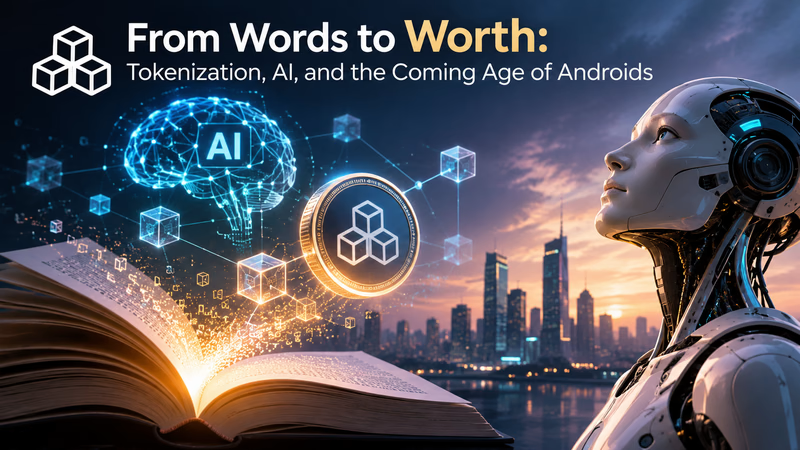
Why not use whole words?
A word-based approach would need an enormous vocabulary and would fail on new or unknown words. Subword tokenization solves this by breaking unfamiliar words into known parts. A model may not know "unfriendable," but it understands "un," "friend," and "able." This makes AI flexible and able to handle slang, typos, and new words without any extra effort.
Common algorithms
The most common methods are Byte-Pair Encoding (BPE), WordPiece, and SentencePiece. Each one builds a vocabulary of frequent words and word-parts from training data. BPE merges the most common character pairs step by step. WordPiece chooses merges based on likelihood and is used in models like BERT. SentencePiece treats text as a raw stream of characters, which works well for languages like Japanese or Chinese.
Why it matters
Tokenization decides how much text a model can handle and how much you pay for it. On average, one token is about ¾ of an English word. The context window is measured in tokens, and API pricing is charged per token. Understanding this helps you write better prompts and keep costs down.
The Tokenization of Values
But tokenization is no longer only about text. We are now entering an age where values themselves are being tokenized. Reputation, trust, attention, and even human worth are increasingly broken down into measurable units—likes, scores, ratings, and credits. Just as AI turns language into tokens, society is turning people into numbers. This is the deeper phenomenon of our time, and it deserves careful thought.
Humans Represented by AI and Androids
As AI grows more capable, it increasingly represents us. Chatbots speak for companies, avatars stand in for people, and androids may one day act on our behalf in the physical world. In this future, tokenization becomes more than a technical step—it becomes a way of translating human intention into machine action. The question is no longer whether machines can understand us, but how much of ourselves we are willing to hand over to them.
A Future That Belongs to Tokenization
The future belongs to tokenization and AI. They will shape how we communicate, how we work, and how we see ourselves. But as machines take on more of our roles, we must decide what remains uniquely human. Tokenization can break language into pieces—but meaning, empathy, and responsibility must stay in our hands.
In short, tokenization is the first step that lets AI process human language. How we use it—and what we let it represent—will define the world to come.